Skip to content

Japanese : https://i-rich.org/?p=2591

Sawada Kenichi
Senior Researcher
 International Research Institute of Controversial Histories

Very early at the beginning of 2026, on January 10, a newly found fact was introduced during

an NHK TV program “Intelligent Exploratory Frontier by Tamori and Yamanaka Shinya—gigantic volcanic eruption gave birth to the “Japanese people!?” It was explained that the root of Japanese-ness derives from gigantic volcanic eruptions and people constantly exposed to the crises of volcanic eruption came to be equipped with a sense of awe toward nature and very active in terms of helping each other.

In addition, gene D-M55, typical to the Jomon people, and fear-inducing gene are explained, which make people fit for group-living and enhance people’s ability to discern danger. And it was also explained that cooperativeness is the key to overcoming difficulties. That is, to help each other and to be eager to sacrifice oneself for the sake of others. This TV program was very interesting to watch, dealing with various fields of physiology, genetics and earth physics.

Incidentally, regarding the Jomon people, who were the Japanese people’s ancestors, how did they come to the Japanese Archipelago?

The ancestors of the modern humans “Homo sapiens” are said to have originated in Africa about 200,000 years ago. Then, they moved to every part of the earth. In 2020, the University of Tokyo and others announced that not only Japanese Jomon people but also all the eastern Eurasians came via the southern route. They decisively asserted not “many” but “all” of them.

Homo sapiens, ancestors of the Jomon people are said to have reached as far as Indonesia about 70,000 years ago. Toba volcano erupted about 74,000 years ago. In the southern part of India, stoneware was unearthed from under the volcanic ash stratum.

Also, in Australia, a stone ax with a polished blade dating back to about 65,000 years ago was unearthed. This was a polished stone ax and with this tool in hand, people gained the ability to cut down big trees and make boats of wood.

Aboard their log boats, they arrived at the southwestern tip of Kyushu about 40, 000 years ago. Starting from the present Kalimantan (Borneo Island) aboard boats, stopping at the Okinawa islands, they arrived at the Honshu island. It was not at all easy to complete the nearly three thousand kilometers long voyage, riding against Kuroshio Current, one of the world’s strongest currents.

When a log boat got upset by transverse waves, throwing a member of the fellow crew into the sea, they helped each other up aboard the boat again. To desert those thrown into the sea meant to lose rowers of the boat, leading to death of oneself. That was why a strong comradeship was naturally born. To save others’ lives was tantamount to saving one’s own life. With this strong bond, only one thousand people finally arrived at the Japanese Archipelago, which is revealed by nuclear DNA analysis. The first group of the Japanese people were mere one thousand. Out of this group of one thousand people were formed the Jomon people.

It was a geopolitically lucky event that the Jomon people came to live in the Japanese Archipelago. Japanese Archipelago is surrounded by the seas and there was no danger of being the victims of wars waged by other peoples and no attempt was made to wage a war against other peoples and kill enemies.

From the ruins of the Jomon people, no weapons to kill others have been unearthed. After rice-growing was introduced during the Yayoi people’s period, probably there were wars over harvested rice and other crops and among the Haniwa figurines, some were made to resemble warriors. However, in Japan, which had never experienced a war waged by other peoples, there were a few wars or a few war casualties.

Certainly, in the short term, for one hundred years from the latter half of the fifteenth century and in the long term, for one hundred and fifty years, there was Sengoku, or warring-states period when one war after another took place. Even during this period, war was fought exclusively among warriors and in principle, there were no civilian deaths involved in the war. Clearly, Japan experienced few wars.

In the first half of the twentieth century, the Japanese people fiercely fought but it was for the cause or mission of self-defense or liberation of Asia that Japanese fought so violently, willing to sacrifice their own lives.

The Japanese people with such national trait cannot have massacred as many as 300,000 guiltless civilians at the time of siege of Nanjing in 1937. The supreme leader at the time of the establishment of the present People’s Republic of China Mao Zedong himself said, in Yan’an, half a year after the siege of Nanjing, “The Japanese Army had many sieges but few annihilations.” This means that there was no massacre, doesn’t it?

Nonetheless, at present, the Chinese government built the Memorial Hall of the Victims in Nanjing Massacre by Japanese Invaders in the city of Nanjing, citing the Japanese Army killed 300,000 people.

After all, is it that this memorial hall reflects the self-image of the Chinese culture that prefers wars and nonchalantly commits one massacre after another. In that, this memorial hall can be said to be the symbol of the self-image of the horrible China or a symbol of China’s shame.

It was a profound discovery that the NHK’s program this time reveals that Japanese people’s cooperative and mutually assisting trait was formed through the rice cultivating culture that requires unified cooperation of many people and that at the same time genetically Japanese people have this tendency.

Japan should disseminate to the world its proud history with more confidence. Getting rid of the misunderstanding that the Japanese people are belligerent, Japan should conciliate countries of the world.    

Japanese : https://i-rich.org/?p=1996

Sawada Kenichi
Senior Researcher of International Research Institute

Introduction

Some people say, “The Ainu are a northern people,” “The Aine are not the descendants of the Jomon people,” or “The Ainu are not a Japanese people.” However, these are misunderstood conceptions which may shake the foundation of Japan, and any assertion based on such false recognitions can be extremely dangerous. I will now correct the false recognitions and explain how fallacies put Japan into a crisis.

Mr. Matoba Mitsuaki of Hokkaido is regarded as the leader of the conservative view regarding Hokkaido, and I pay due respect to him for his work. However, when it comes to the issue of Ainu, his view is utterly misleading, and I cannot help condemning him for the dangerous direction to which he may be leading Japan. Let me explain why so.

The fault of Mr. Matoba’s assertion

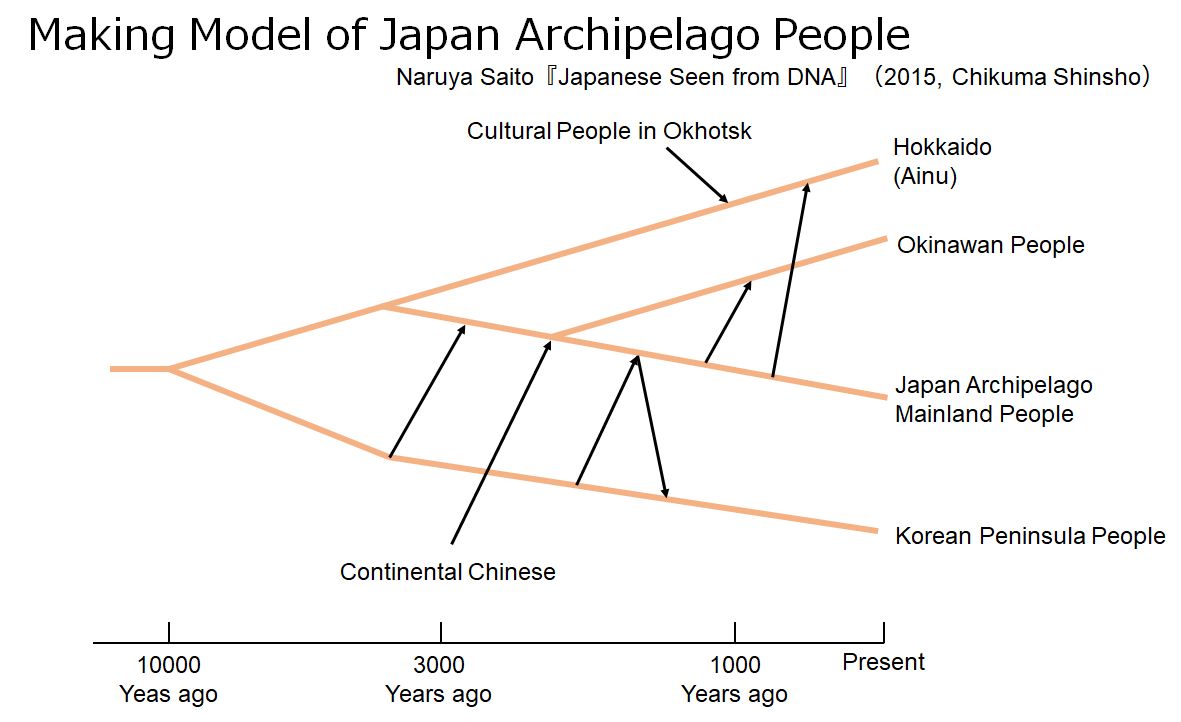
Once I received a text message from a friend asking if I had seen YouTube video titled “Matoba Class #60: History tells of the Ainu’s genetic element of the Jomon people.”[i] I did not see the video and so immediately checked it. The part of the video about 37 minutes into it, which my friend described as totally astounding, was the most extraordinary explanation that “Ainu are not the descendants of Jomon people, using a chart (Chart 1) of the pedigree which shows Ainu in Hokkaido, Okinawans and the mainlanders derive from the same branch.

If you read this chart correctly, the Ainu, Okinawans and mainlanders derive from the same genetic branch and are all descendants of the Jomon people. Nevertheless, in the video, a completely opposite explanation is calmly being made, which made me totally astounded.

Then, other people contacted me to point out the video is wrong. This video mostly explains the segregated people. Why is it about the segregated people? That is because Mr. Matoba explains that during the Edo period, a large number of segregated people moved from Honshu in mainland to Hokkaido and mixed with Ainu people. Even if it is true that there were certain cases of mixing with the segregated, it is hardly thinkable that all of them were mixed. Even so, this conclusion is clearly wrong.

Chart 1 The Formation Model of people of the Japanese archipelago from the book Japanese People Seen from DNA, written by Saito Naruya, Chikuma Shinsho, 2015.

According to Mr. Matoba’s explanation, “the Ainu people are northern tribe having nothing to do with the Jomon people.” That is, the original Ainu did not have Jomon people’s genes, but the segregated people came and mixed with Ainu, through which Jomon people’s genes entered Ainu people. However, the present-day mainlanders possess about 10% of the genes deriving from the Jomon people. Against this percentage, today’s Ainu people possess about 70% of genes deriving from the Jomon people.[ii] [iii] Should all Ainu people have genetically become segregated people, the ratio of their genes could never reach 70%. It would have been 10% at most.

Using the segregated people up front in a manner like this is extremely inappropriate and poses a serious human rights issue. An academic mistake can be corrected, but a statement made concerning human rights cannot be corrected academically.

Mr. Matoba’s view has many other faults. Let me mention just one more. Thirty-six minutes into the video in question, immediately after Mr. Saito Naruya said, “Ainu are the direct descendants of Jomon people,” Mr. Saito said, “It’s not true,” and this scene is repeatedly quoted. By doing so, it is explained as if Mr. Saito said, “Ainu are not Jomon people’s descendants.”

In fact, I had seen Mr. Saito’s video “Ethnical relationship in East Asia seen from genetic analysis”[iv] before and felt great sense of disparity at the above-mentioned scene, because Mr. Saito squarely explains that Ainu are descendants of the Jomon people in his books. So, I directly called Mr. Saito on the phone to confirm it. Mr. Saito said what Mr. Saito meant in the video was “they were not 100% Jomon people.” I would like Mr. Matoba to read Mr. Saito Naruya’s books once again.

To sum up, what the chart means in Mr. Matoba’s video in question is explained in the context which is opposite to the author’s intention, and this is an academic problem. At the same time, he lightly uses the segregated people in his explanation, which can be said to include a serious human rights issue. It can be concluded that the assertion in the video “Matoba school series #60: History tells the Ainu people’s genetic element of the Jomon people” is inadequate and misleads public opinion.

The danger in Mr. Matoba’s assertion with respect to the relationship with Russia   

Academic errors will occur. Those errors are to be corrected through academic controversies over time. However, when it comes to the issue related to the Ainu, we cannot be so slow and time-consuming. I will explain the reason for quick action now.

Mr. Matoba says that Ainu are a northern tribe who used to live along the Amur River. Then, the Ainu people would become Russian, of which Russian President Putin promptly took advantage. The Hokkaido Shimbun dated December 19, 2018, reported that Russian President Putin showed his intention to acknowledge Ainu people as indigenous Russians. Along this line, J-cast News of April 7, 2022, reported: Russian political science scholar Sergei Chernyakhovsky asserts, “Tokyo (the Japanese Government) inappropriately owns Hokkaido, which was politically Russian territory. As one of the grounds for the assertion it was mentioned that the Ainu people living in Hokkaido are one of Russian peoples. On the next day, April 8, 2022, Vice-Chairman Sergei Mironof of the Russian Lower House reportedly said, “According to experts, the entire hegemony of Hokkaido rests on Russia,” according to zakzak, the official website of Evening Fuji, published by the Sankei Shimbun Company.

Surprisingly, the Japanese Ministry of Education, Culture, Sports, Science and Technology has followed this trend. It instructed that since Hokkaido was inhabited by more populations of other peoples than Japanese up to the Edo period, Hokkaido before the Meiji era did not belong to Japan. In the school textbook accreditation of geology, it was instructed that Hokkaido be shown in white while other parts south of Hokkaido be colored. Thus, logically, Hokkaido is no longer called Japan’s inherent territory.

Under such circumstances, Japan is in the extremely disadvantageous position when it comes to the northern territorial issue. Etorofu and Kunashiri will be no longer Japanese people’s inherent islands. People lived there were Ainu and should Ainu be regarded as Russian people, Japan’s claim to the region will be completely toppled. Let alone, Russia is already claiming its territorial right to Hokkaido, as mentioned above

Should Japan leave these situations as they are, fearfully Japan may become a second Ukraine. In fact, The Newsweek Japan of November 25, 2022, reported, “Russia had been prepared for attack against Japan, not against Ukraine.” This was revealed by email text of an insider of FSB (Federal Security Service of the Russian Federation, formerly KGB). We don’t know how trustworthy this peace of information was, but whether true or not, we must not overlook it nor underestimate Russia.

Ainu seen from genome

According to the study jointly announced in August 2020 by The University of Tokyo, The University of Tokyo Graduate School and Kanazawa University, “Ancient Jomon genome sequence analysis sheds light on migration patterns of early East Asian populations[v], “Ainu are the oldest lineage as inhabitants of Japanese Archipelago and at the same time, highly probably one of the direct descendants of original East Eurasian groups and the lineage of Jomon people is “so old as to compose the “root” of East Eurasians (East Asians, Northeast Asians) and one of the direct descendants of the original East Eurasian populations.”

In gist, Ainu are descendants of Jomon people and therefore genuine Japanese people and more detailedly the oldest inhabitants of the Japanese Archipelago. Ever since recorded history, Hokkaido and Chishima Islands have been inhabited by none but the Japanese people. There is no room for ethnic issues whatsoever. On the contrary, the Japanese people advanced to East Eurasian Continent. In archaeology, in Siberia of the Eurasian Continent, no other ruins are older than those in Japan. Jomon potteries unearthed along the middle and lower Amur are much newer than those found in Japan. The ancient people most certainly came to settle in Siberia, advancing from Japan. If this was the case, Siberia surely belongs to Japan after Putin’s argument.

Certainly, “Ebisu people” and “Emishi people” in the north conflicted with the central government and in order to conquer them, the Barbarian Quelling Generalissimo was appointed and became leader of the Japanese government as “Bakuhu”. The “Bakufu” government and “Ebisu” were key players in Japan’s history, like two sides of the same coin. There is no room at all for Russia to intervene in such history. We must not be trapped into a plot aiming to divide the Japanese people and the conservative parties must duly cope with Russia, sharing this historical view. For that cause, no one should make the wrong assertion related to the Ainu people. 


[i] Matoba Mitsuaski, YouTube “Matoba Intensive Course No. 8 Jomon people’s DNA mixed with the modern Ainu people” (February, 2024) Since this study of mine aims to directly criticize this video of Mr. Matoba, I would like to post this video as below. This video is in Japanese and those who read this “study” in English translation may not fully understand it. I apologize for the inconvenience in advance.

Scholars and researchers cannot speak about the Jomon people’s DNA mixed with Ainu [Matoba...] Accessed by the author as latest as April 27, 2024.  https://www.youtube.com/watch?V=B7cc9OtqPo4

[ii] The Nihon Keizai Shimbun of May 13, 2019 “The origin of the Jomon people probably dates back to 20,000 ~40,000 ago, the National Museum of Nature and Science analyses genomes.

[iii] Hideaki Kanzawa-Kiriyama, Timothy A. Jinam, Yosuke Kawai, Takehiro Sato, Kazuyoshi Hosomichi, Atsuhi Tajima, Noboru Adachi, Hirofumi Matsumura, Kirill Kryukov, Naruya Saito, Ken-ichi Shinoda, Late Jomon male and female genome sequences from the Funadomari site in Hokkaido, Japan, Anthropological Science, Essay ID 190415, publication date 2019/05/29

[iv] Saito Naruya’s YouTube video “The ethnical relationship seen from generic analysis,” (June 2021). This video is also in Japanese. Those who read my paper in English may not fully understand it. The part of this video (twenty minutes into it) is cut out and used in Mr. Matoba’s video of Note 1. But this explanation is introduced in the opposite context to what Mr. Saito means. By the way, Mr. Saito’s books of the same effect are The DNA tells the root of the Japanese people (Bessatsu Takarajima, 2016) and The Origin of the Japanese people traced through nuclear DNA analysis (Kawade shobo, 2017). The author’s latest access to the video: April 27, 2024. https://youtu.be/nb5eunteGa0

[v] Takashi Gakuhari, Shigeki Nokagome, Simon Rasmussen, Morten E. Allentoft, Takehiro Sato, Thorfinn Kornelliussen, Blanaid Ni Chuinneagain, Hiromi Matsumae, Kae Koganebuchi, Ryan Schmidt, Souichiro Mizushima, Osamu Kondo, Nobuo Shigehara, Minoru Yoneda, Ryosuke Kimura, Hajime Ishida, Tadayuki Masuyama, Yasuhiro Yamada, Atsushi Tajima, Hiroki Shibata, Atsushi Toyoda, Toshiyuki Tsurumoto, Tetsuaki Wakebe, Hiromi Shitara, Tsunehiro Hanihara, Eske Willerslev, Martin Sikora, Hiroki Oota, Ancient Jomon genome sequence analysis sheds light on migration patterns of early East Asian populations, Communications Biology 2020

Chart:

Okhotsk Culture people   Hokkaido (Ainu people)  Okinawans  Japan Archipelago mainlanders    Continental Chinese   Korean Peninsula people

10,000 years ago   3,000 years ago  1,000 years ago  present

Japanese : https://i-rich.org/?p=1352

Senior researcher

Sawada Kenichi

February 2023

Scientific fact that the Ainu are not an indigenous people of a different ethnic group but the same as the Japanese people

In May 2019, a joint study team composed of the National Museum of Nature and Science, the University of Tokyo, Kanazawa University and others made an important announcement: “The Ainu people have 70% of the nuclear DNA of the Jomon people[a1] [q2] .”[i] This is a fact, scientifically demonstrated; the Ainu are infallibly descendants of the ancient Japanese Jomon people, who have lived in Hokkaido since the Jomon period. Therefore, the assertion that the Ainu are a northern people who came to settle in Hokkaido from the Middle Ages onwards has been proven to be entirely false.

Furthermore, in the contents of study of “Human history of East Eurasia revealed by the genome analysis of the Jomon people,” it is stated that Honshu Jomon IK002 (female Jomon skeleton unearthed at Ikawatsu kaizuka (shell mound) in Aichi Prefecture) is included in Ainu cluster (or group). This result agrees with the analysis of the entire genome of Hokkaido Ainu people and shows that it is highly probable that the Ainu people are the oldest inhabitants of the Japanese archipelago and at the same time a direct descendant of the first group of East Eurasians.[ii]

In addition, the announcement from the University of Tokyo states, “The genome of the Jomon IK002 is an old group that can be said to be rooted in East Eurasian and the southern route [of migration], hardly affected by the northern route [of migration].” In other words, the Jomon people (including those would be later called “Ainu”) are a people who originated from the southern route. This challenges the assertion made by Japanese archeologists that “the Ainu are a northern people”.

What these facts tell us is that the Ainu people are descendants of the Jomon people who lived in Hokkaido since the Jomon period and that they mostly originated from people who migrated from the south, not the north, and very probably those who migrated to the continent mixed with East Eurasians.

Russia’s move, Putin’s assertion and internal left-wing power play

In Russia, however, assertions not based on science have been made. In December 2018, it was reported that Russia’s President Putin intended to acknowledge the Ainu people as indigenous Russians.[iii] Furthermore, in April 2022, vice-chairman of the State Duma, the lower house of the Russian Parliament, Sergei Mironov reportedly stated, “According to certain experts, Russia owns all rights in Hokkaido.”[iv]

Also in April 2022, “According to Regunam News [Russian web-media], political scientist Sergei Chernyakhovsky maintained that ‘Tokyo [the Japanese Government] improperly retains Hokkaido, which was politically Russian territory.’[v] Referring to the assertion made in the Treaty of Commerce and Navigation between Japan and Russia concluded in 1855, the report stated: “There [in Hokkaido] the Ainu people lived. They are the same people that live in Sakhalin, in the suburbs of Vladivostok and in the south of the Kamchatka Peninsula and are one of the peoples of Russia.”

Let us put President Putin’s assertion in the current context. In September 2022, he stated a new diplomatic policy, called “Russia’s World” and stipulated that Russia will intervene in countries in support of Russian inhabitants.[vi] And according to another report, Russia planned to militarily intervene in Hokkaido before it invaded Ukraine.[vii]

In response to these Russian intentions, in Japan, there was some leftists called up on Putin for assistance. In January 2019, a group calling themselves Moshirikoru Kamui no Kai (its representative director Hatakeyama Satoshi, Ishi Pompei as vice director) issued a “written request to President Vladimir Putin.”[viii] In this request, they asked President Putin to consider “inclusive security management” of the Shiretoko Peninsula [Hokkaido], in addition to making the Kuril Islands [or Chishima Retto] an Ainu autonomous zone. It sounds as if this group was gladly offering Hokkaido to Putin.

Japanese conservative journalists and the Japanese Government’s confusion of the Ainu invites crisis

Unfortunately, the thinking that the Ainu are a “northern” people is not monopolized by Russians and Japanese leftists. In fact, many Japanese conservative journalists also believe this. The most radical among them is Mr. Matoba Mitsuaki. In 2019, Mr. Matoba stated in his book: “Mr. Shinoda [Shinoda Kenichi, director of the National Museum of Nature and Science] concluded that modern Ainu people, influenced by people of the Okhotsk ethnic group turned out to be genetically related to indigenous Siberians. This turns out to be perfectly consistent with the archaeological study reports so far, without the least contradiction.”[ix] Moreover, elsewhere, he stated, “The Ainu are not the descendants of the Jomon people.”

Matoba’s assertion coincides exactly with what President Putin stated. This assertion was made despite his knowledge of many recent studies of ancient DNA. Mr. Matoba lives in Hokkaido and is considered as a conservative Hokkaido journalist. In other words, a conservative journalist in Hokkaido and a Japanese leftist group share the same thinking, that “the Ainu are a northern people.” This is more than Putin could have asked for.

Moreover, the Japanese Government’s view of the issue will invite further misunderstanding. For instance, regarding “measures related to the Ainu in the website of the Ministry of Land, Infrastructure, Transportation and Tourism, “In view of history from the end of the Middle Ages onwards, the Ainu people are considered to have indigenously lived with relation to ‘Wa-jin [ancient Japanese people]’ at that time.” This passage invites the misunderstanding that the Ainu are not Japanese. The government’s account is based a report from the “Advisory Panel of Experts on Measures to be Taken for Utari [brethren or fellow countrymen]” issued April, 1996, over a quarter century ago.[x]

In addition, a “Resolution to Decide That The Ainu Are An Indigenous People,” adopted by regular sessions of both the House of Representatives and the House of Councilors, simultaneously in June 2008, used the same wordings and stated that the Ainu are an indigenous people who inhabited the northern part of the Japanese archipelago, particularly Hokkaido, and that they are an indigenous people having their own language, religion and culture.

That “the Ainu are a northern people, different from the Japanese people” which is held to be true by many scholars is groundless yet this assertion was backed by the Government of Japan and by both Houses of the Diet.

To not make Hokkaido a second Ukraine

Russia launched its invasion of Ukraine in the name of protecting Russians. It was nothing but a unilateral accusation, totally ignoring historical facts, the actual situation and the assertion on the part of the other. In other words, without considering the views of other countries, Russia will invade other countries if the cause is to protect its own people (even if it is contorted or false).

Russia made up the pretext, that “the Ainu are Russian”, and began to outrageously state that “sovereignty over Hokkaido belongs to Russia.” If such a ridiculous assertion becomes acceptable within Russia, Russia will start to assert its sovereignty over Hokkaido. Should this become a reality, an invasion of Hokkaido would be as sure as an invasion of Ukraine.

This time, I used genetics to show the commonality of the Ainu and the Japanese. I will add that there is much more evidence to prove that the Ainu are descendants of the Jomon people.

Under this grave situation in which dangerous statements are made lies the Japanese Government’s ambiguous Ainu policy. The Japanese Government must correct its past mistake which ignored the science. Instead, the Japanese Government must recognize the Ainu based on the science. The government should never acknowledge diversity for its own sake. The Japanese Government should recognize the Ainu as Japanese people.


[i] “The origin of the Jomon people consecutively revealed through genes—the Jomon people’s highly accurate genomes successfully obtained.” Independent Administrative Agency National Museum of Nature and Science, May 13, 2019.

[ii] “Human history of East Eurasia revealed through the analysis of the Jomon people’s genomes.” The University of Tokyo, the graduate school of the University of Tokyo, Kanazawa University, August 25, 2020.

[iii] “The Ainu people are Russia’s indigenous people,” Hokkaido Newspaper, morning edition, December 19, 2018.

[iv] “Owning rights in Hokkaido, Russian political world aims to check Japan’s movement.” Jiji.Com, April 9, 2022

[v]“‘Hokkaido’s rights belong to Russia’, Russian Parliament member claims amid the confusion caused by the war. On what grounds?” J-Cast News, April 7, 2022.

[vi] “President Putin approves a new diplomatic policy, emphasizes support of “comrades” living overseas.” Newsweek, Japan edition, September 6, 2022.

[vii] “Russia prepared to attack not Ukraine but Japan. The Newsweek obtained email of a betrayer within FSB (Federal Security Service of the Russian Federation). Newsweek, Japan, November 25. 2022. 

[viii]“Written Request Addressed to President Vladimir Putin,” Moshirikor Kamui no Kai Society, January 11, 2019.

[ix] “Scientific denial of the theory that the Ainu are an indigenous people,” written by Matoba Mitsuaki, published by Matoba Mitsuaki Office, November 1, 2019, first edition, pp.224-225.

[x] The “Advisory Panel of Experts on Measures to be taken for Utari (meaning brethren, fellow countrymen)” chaired by Ito Masami, professor emeritus, the University of Tokyo, April 1, 1996,


 [a1]Paper from this group says “arctic” and not Jomon, Can you check again?

 [q2]The paper says “Jomon” not arctic.

See attached.